
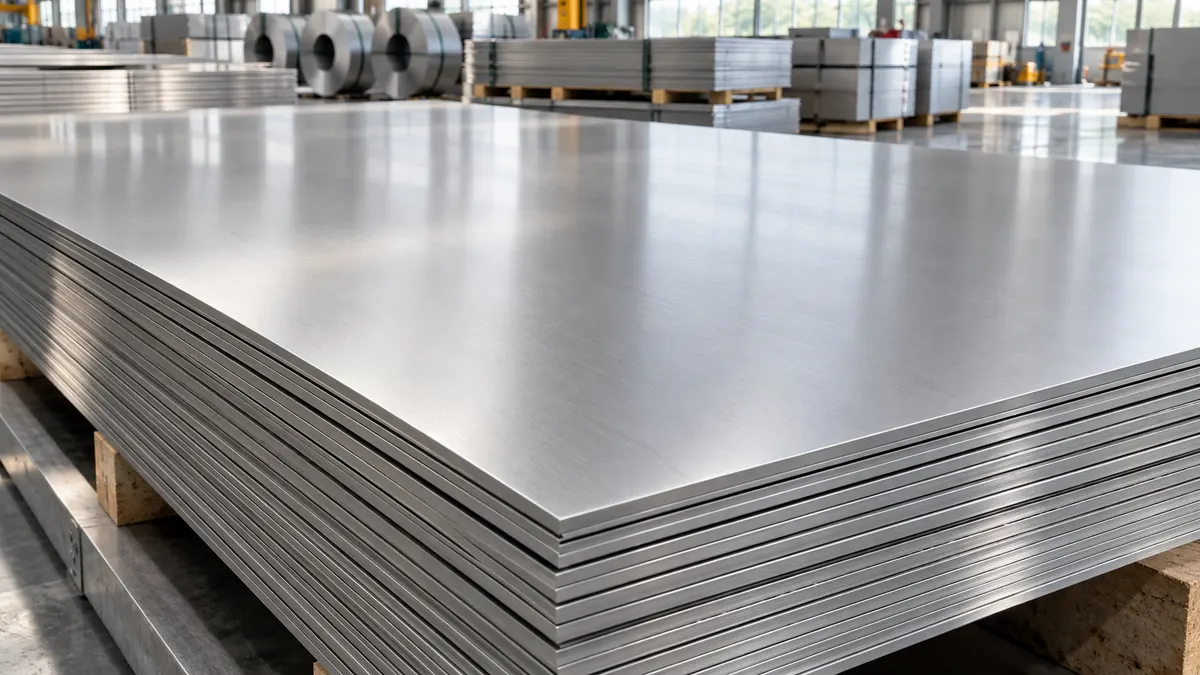
In searches for 304 stainless steel 2B finish, buyers are usually checking what appearance and processing they will receive. “304” identifies the stainless steel grade family in common designation systems; “2B” identifies a standard mill surface finish. The two terms answer different questions, and neither one alone is a complete purchase specification.
What is a 2B finish?
The Guide to Stainless Steel Finishes describes 2B as a cold-rolled, heat-treated, pickled, and skin-passed finish. It is a common smooth mill finish with a more even appearance than 2D. The exact appearance can vary with the product, mill, and handling, so a sample or agreed reference may be useful when appearance is critical.
2B is not the same as a mirror polish, brushed finish, or guaranteed roughness value. It is a finish designation describing a production route and resulting surface category. If the part will be polished, coated, welded, or used as a visible surface, confirm that the supplied finish and any later processing meet the end-use requirement.
2B, 2D, and BA are different finishes
| Finish | General description | Buyer consideration |
|---|---|---|
| 2B | Cold-rolled, heat-treated, pickled, then skin-passed | Common general-purpose mill finish; confirm visual consistency and any protective film requirement |
| 2D | Cold-rolled, heat-treated, and pickled, with a duller appearance | Consider when a less reflective surface is acceptable or further processing is planned |
| BA / 2R | Bright annealed, typically smoother and brighter than 2B | Specify when a brighter appearance is needed; confirm the exact finish notation in the governing product standard |
These labels do not by themselves rank corrosion resistance for every application. Grade, environment, surface condition, cleaning, fabrication, and maintenance also matter.
What “304 2B” does not tell you
An order that says only “304 2B” leaves important details open. It does not identify the product standard, exact dimensions, tolerances, whether one or both sides need a particular appearance, whether a protective film is required, or whether the material needs a project-specific inspection record.
For stainless flat products, standards such as ASTM A240/A240M identify product requirements for grades and forms, while ASTM A480/A480M addresses general requirements for flat-rolled stainless and heat-resisting plate, sheet, and strip. Use the standard and edition named by the project, and confirm the finish designation within that purchasing basis.
A practical purchase description
For a clear RFQ or purchase order, state:
- Grade and product standard, such as the project-specified 304 designation and standard edition.
- Product form: plate, sheet, coil, or strip.
- Nominal thickness, width, length, and dimensional tolerance basis.
- Surface finish designation, such as 2B, and any side-specific requirement.
- Protective film, surface protection, edge condition, and packing requirements.
- Inspection, marking, and certificate requirements.
If a particular color, reflectivity, or surface texture is essential, attach a sample, drawing, or measurable acceptance criterion instead of relying on the word “2B” alone. Review the delivered material under consistent lighting and handling conditions agreed with the supplier.
See our 304 stainless steel plate listing for the product form, and send the full grade, size, finish, quantity, destination, and document requirements in a steel RFQ. For related grade selection, consult the stainless steel grades guide.
References
Turn the material requirement into an RFQ.
Review the product index or send grade, dimensions, quantity, destination and document requirements to the export desk.