
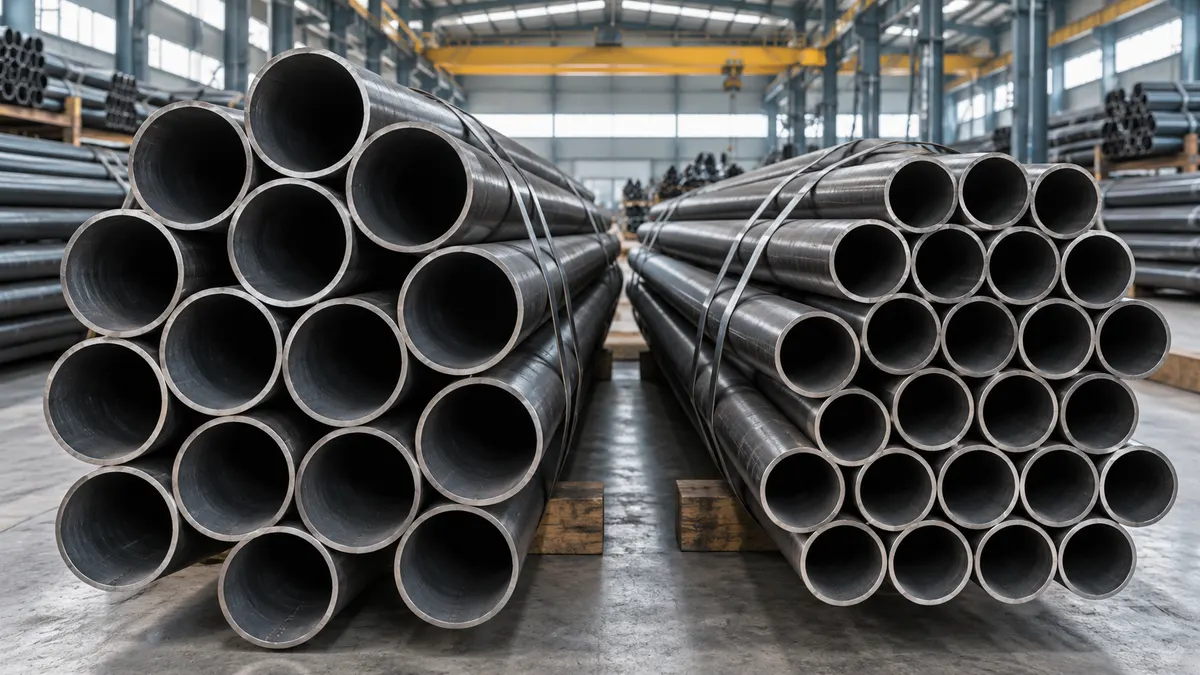
The useful question in an A53 vs A106 Grade B pipe comparison is not which grade is universally better. It is which specification matches the service, manufacturing route, and project documents. ASTM A53/A53M covers welded and seamless steel pipe, including black and hot-dipped zinc-coated pipe, for mechanical and pressure applications and ordinary steam, water, gas, and air lines. ASTM A106/A106M covers seamless carbon steel pipe for high-temperature service.
Both specifications include Grade B, but the shared grade letter does not make the products interchangeable. The purchase order and applicable design code decide what is acceptable.
A53 and A106 at a glance
| Order question | ASTM A53 Grade B | ASTM A106 Grade B |
|---|---|---|
| Product scope | Welded or seamless steel pipe; black or hot-dipped zinc-coated options are within the specification | Seamless carbon steel pipe for high-temperature service |
| Manufacturing choice | Types include electric-resistance welded and seamless; the order should identify the permitted type | Seamless only under this specification |
| Typical specification purpose | Mechanical and pressure use, plus ordinary service such as steam, water, gas, and air | Elevated-temperature service where the design and piping code call for this specification |
| Surface/coating | Black or hot-dipped galvanized product is within A53's scope; state coating and finish requirements | A106's scope is seamless carbon steel pipe; specify any separately required surface treatment explicitly |
This summary describes the standards' scope. It does not establish that either pipe is suitable for a particular pressure, temperature, fluid, or design life.
When A53 Grade B may fit
A53 can be relevant when the project permits welded or seamless pipe and the requested service is within the specification. The standard includes black and hot-dipped zinc-coated pipe. If a project requires seamless pipe, a particular A53 type, or galvanizing, make that requirement explicit; do not assume the grade designation selects the manufacturing route or finish by itself.
The A53 specification also cautions that nominal pipe size is a designation rather than the measured outside diameter, and nominal wall thickness is not a promise that every measured point equals that value. Use the dimension standard and tolerances stated in the order.
When A106 Grade B may fit
A106 is specifically a seamless carbon steel pipe specification for high-temperature service. That scope makes it a candidate when the project design calls for seamless pipe under A106, but it is not a substitute for checking the design temperature, pressure, material requirements, and code.
Do not choose A106 merely because the word “high-temperature” appears in its title. The engineer or project specification must establish the required material and allowable design conditions.
Can A53 Grade B replace A106 Grade B?
Not automatically. A53 includes welded product forms and ordinary service applications; A106 is seamless and intended for high-temperature service. Even where a size and nominal grade look similar, qualification depends on the design code, service conditions, required tests, manufacturing route, and project approval.
Before accepting a proposed substitution, have the responsible engineer confirm it against the governing code and project specification. A supplier comparison or certificate cannot independently approve a design substitution.
What to put in the pipe RFQ
Specify the complete requirement rather than sending only “Grade B”:
- ASTM designation and edition required by the project.
- Grade and manufacturing type or route, including whether seamless is mandatory.
- Nominal pipe size, schedule or wall thickness, outside diameter basis, and length.
- Black or galvanized finish and any coating requirement.
- Required tests, inspection documents, marking, and traceability.
- Service design conditions and the code or project document that governs selection.
For an A53 seamless and welded carbon steel pipe or A106 Grade B steel pipe inquiry, include the project specification and requested manufacturing route. Our steel MTC and inspection guide explains how to state certificate and traceability needs.
References
Turn the material requirement into an RFQ.
Review the product index or send grade, dimensions, quantity, destination and document requirements to the export desk.