
Calculation method
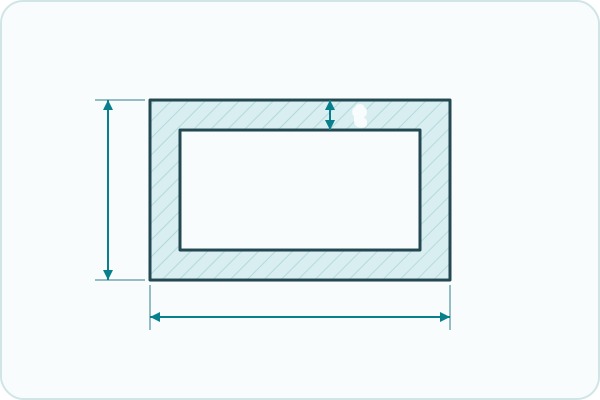
Calculate ideal rectangular hollow-section mass from outside width, outside height, wall thickness and length.
What this calculator helps you check
Read the quantities that matter
- Mass per lengthm/L · kg/m
- Mass per piecem · kg
- Total massΣm · kg
Compare dimensions, keep the calculation
Add rows to compare alternatives, switch between metric and imperial units, then copy the results or download a CSV with the input dimensions.
Formula
The metal area is bh−(b−2t)(h−2t). Width and height are outside dimensions and the same wall thickness is used on all sides.
A = bh − (b − 2t)(h − 2t); m/L = A × ρ × 10⁻⁶How to use it
- Use consistent units
Choose the unit system and enter the actual dimensions.
- Dimensions and assumptions
Enter both outside side lengths, wall thickness and piece length.
- Check the result
Review the formula and its assumptions before using the result. Copy or download results with their units and assumptions.
Worked example
Follow one set of dimensions from inputs to calculated results.
Inputs
- Width
- 100 mm
- Height
- 50 mm
- Wall or plate thickness
- 5 mm
- Length
- 2 m
- Density
- 7,850 kg/m³
- Quantity
- 1
Density is an explicit assumption in this example. Use the value appropriate to your material.
Calculation results
- Mass per length
- 10.99 kg/m
- Mass per piece
- 21.98 kg
- Total mass
- 21.98 kg
A sharp-corner 100 × 50 × 5 mm section has area 1400 mm². At 7850 kg/m³ its theoretical mass is 10.99 kg/m.
Limits
The formula assumes sharp corners and uniform wall. It is not an exact rolled or cold-formed RHS catalog property.
Frequently asked questions
Enter both external dimensions and the wall. Do not enter the inside opening as width or height, because the calculation subtracts the opening itself.
Otherwise the assumed inner hollow would have zero or negative width or height.
The mass is unchanged. Its bending properties about a particular axis can change.
Continue with a related calculation
Check your own dimensions
Use your actual measurements in the calculator above. Review the units and assumptions before using the result.