
Calculation method
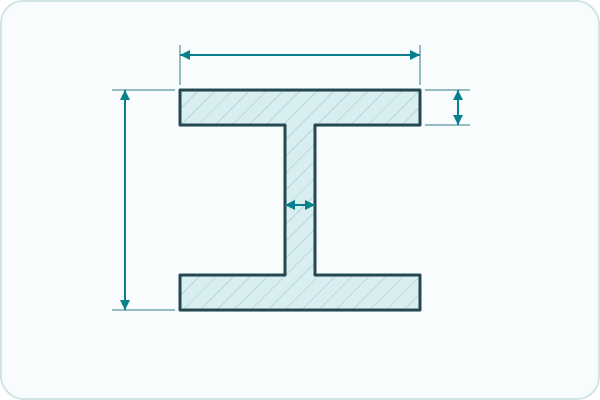
Estimate the mass of an ideal symmetric H section from overall depth, flange width, web thickness and flange thickness.
What this calculator helps you check
Read the quantities that matter
- Mass per lengthm/L · kg/m
- Mass per piecem · kg
- Total massΣm · kg
Compare dimensions, keep the calculation
Add rows to compare alternatives, switch between metric and imperial units, then copy the results or download a CSV with the input dimensions.
Formula
Area is two rectangular flanges plus the clear-height web: A=2btf+(h−2tf)tw. The web is centred and both flanges are identical.
A = 2btf + (h − 2tf)tw; m/L = A × ρ × 10⁻⁶How to use it
- Use consistent units
Choose the unit system and enter the actual dimensions.
- Dimensions and assumptions
Use the total depth and flange width, then specify flange and web thickness separately.
- Check the result
Review the formula and its assumptions before using the result. Copy or download results with their units and assumptions.
Worked example
Follow one set of dimensions from inputs to calculated results.
Inputs
- Height
- 200 mm
- Width
- 100 mm
- Web thickness
- 6 mm
- Flange thickness
- 10 mm
- Length
- 2 m
- Density
- 7,850 kg/m³
- Quantity
- 1
Density is an explicit assumption in this example. Use the value appropriate to your material.
Calculation results
- Mass per length
- 24.178 kg/m
- Mass per piece
- 48.356 kg
- Total mass
- 48.356 kg
For h=200 mm, b=100 mm, tw=6 mm and tf=10 mm, ideal area is 3080 mm²; at 7850 kg/m³ mass is 24.178 kg/m.
Limits
This ideal sharp-corner model excludes root fillets, taper and rolling tolerances. It is not an AISC, EN, JIS or GB section lookup and does not establish structural capacity.
Frequently asked questions
No. Rolled shape mass should come from the applicable verified section table. This tool calculates the geometry you enter without inventing fillet dimensions.
No. The ideal rectangle model omits fillets, tapers and tolerances. A recognized shape table gives the nominal line mass for a designated shape.
The flanges and web often have different thicknesses, so a single thickness does not define the area.
Continue with a related calculation
Check your own dimensions
Use your actual measurements in the calculator above. Review the units and assumptions before using the result.