
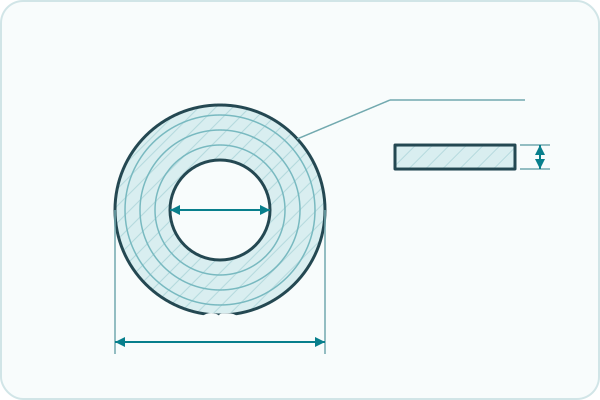
Calculation method
Estimate the outside diameter of an ideal tightly wound steel strip coil from net strip mass, inner diameter, width and density.
What this calculator helps you check
Read the quantities that matter
- Outside diameterD · mm
Compare dimensions, keep the calculation
Add rows to compare alternatives, switch between metric and imperial units, then copy the results or download a CSV with the input dimensions.
Formula
Convert strip mass to volume using density. Divide volume by strip width to find annular area, then solve for outside diameter.
D = √[d² + 4m × 10⁹/(πbρ)]How to use it
- Use consistent units
Choose the unit system and enter the actual dimensions.
- Dimensions and assumptions
Enter net strip mass, coil width, inside diameter and material density to calculate the ideal outside diameter.
- Check the result
Review the formula and its assumptions before using the result. Copy or download results with their units and assumptions.
Worked example
Follow one set of dimensions from inputs to calculated results.
Inputs
- Mass
- 5,000 kg
- Inside diameter
- 508 mm
- Width
- 1,000 mm
- Density
- 7,850 kg/m³
Density is an explicit assumption in this example. Use the value appropriate to your material.
Calculation results
- Outside diameter
- 1,033.9461 mm
For 1000 kg of net strip, width 1000 mm, ID 508 mm and density 7850 kg/m³, D²=508²+4×1000×10⁹/(π×1000×7850), giving an ideal outside diameter of approximately 648.275 mm.
Limits
This is a strip-coil model, not a spring or electrical coil calculator. Exclude core and packaging mass; winding gaps and interleaving are not modelled.
Frequently asked questions
In this fully packed annular model, mass, density and width determine annular area. Thickness changes strip length, not the solved ideal outside diameter.
No. It models flat sheet wound around a cylindrical core.
The result assumes a circular tight coil. Use the actual coil measurements and the machine’s stated limits for fit.
Continue with a related calculation
Check your own dimensions
Use your actual measurements in the calculator above. Review the units and assumptions before using the result.