
Calculation method
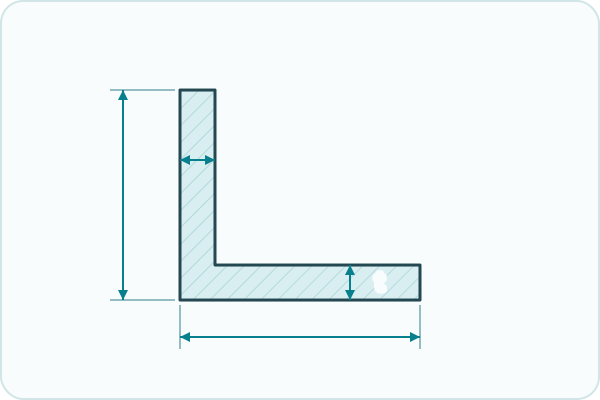
Estimate ideal angle-section mass using outside leg lengths, equal thickness, length and density.
What this calculator helps you check
Read the quantities that matter
- Mass per lengthm/L · kg/m
- Mass per piecem · kg
- Total massΣm · kg
Compare dimensions, keep the calculation
Add rows to compare alternatives, switch between metric and imperial units, then copy the results or download a CSV with the input dimensions.
Formula
The two legs overlap at the corner. Subtract that overlap once: A=t(b+h−t), rather than adding two full rectangles.
A = t(b + h − t); m/L = A × ρ × 10⁻⁶How to use it
- Use consistent units
Choose the unit system and enter the actual dimensions.
- Dimensions and assumptions
Enter the leg sizes and thickness for an ideal constant-thickness angle section.
- Check the result
Review the formula and its assumptions before using the result. Copy or download results with their units and assumptions.
Worked example
Follow one set of dimensions from inputs to calculated results.
Inputs
- Width
- 100 mm
- Height
- 100 mm
- Wall or plate thickness
- 10 mm
- Length
- 2 m
- Density
- 7,850 kg/m³
- Quantity
- 1
Density is an explicit assumption in this example. Use the value appropriate to your material.
Calculation results
- Mass per length
- 14.915 kg/m
- Mass per piece
- 29.83 kg
- Total mass
- 29.83 kg
An ideal 100 × 100 × 10 mm angle has area 1900 mm². At 7850 kg/m³ its theoretical mass is 14.915 kg/m.
Limits
The model has sharp corners and constant equal thickness. Rolled root and toe radii, taper, welds and tolerances are excluded.
Frequently asked questions
Yes. Enter different outside horizontal and vertical leg lengths. Both legs still use the same entered thickness.
No. The overlap where the legs meet is subtracted once in the area formula.
No. Rolled radii, fillets and actual dimensions differ from the ideal angle.
Continue with a related calculation
Check your own dimensions
Use your actual measurements in the calculator above. Review the units and assumptions before using the result.