
Calculation method
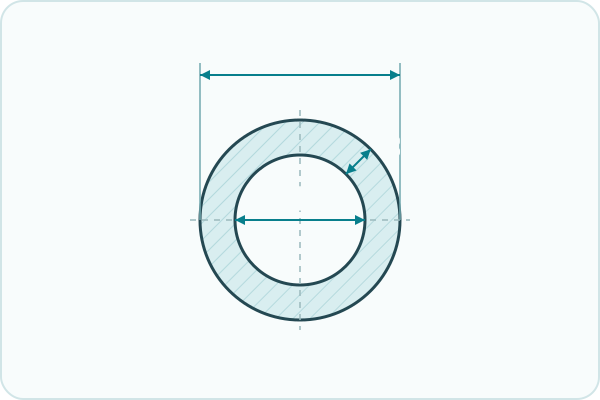
Calculate the theoretical metal mass of a round pipe from outside diameter, wall thickness, length and density.
What this calculator helps you check
Read the quantities that matter
- Mass per lengthm/L · kg/m
- Mass per piecem · kg
- Total massΣm · kg
Compare dimensions, keep the calculation
Add rows to compare alternatives, switch between metric and imperial units, then copy the results or download a CSV with the input dimensions.
Formula
The annular area is πt(D−t), where D is outside diameter and t is wall thickness. Inside diameter is D−2t. Area multiplied by density gives mass per metre.
A = πt(D − t); m/L = A × ρ × 10⁻⁶How to use it
- Use consistent units
Choose the unit system and enter the actual dimensions.
- Dimensions and assumptions
Use the measured outside diameter and wall thickness, not a nominal NPS number in place of diameter.
- Check the result
Review the formula and its assumptions before using the result. Copy or download results with their units and assumptions.
Worked example
Follow one set of dimensions from inputs to calculated results.
Inputs
- Outside diameter
- 60.3 mm
- Wall or plate thickness
- 2 mm
- Length
- 2 m
- Density
- 7,850 kg/m³
- Quantity
- 1
Density is an explicit assumption in this example. Use the value appropriate to your material.
Calculation results
- Mass per length
- 2.8755312 kg/m
- Mass per piece
- 5.7510623 kg
- Total mass
- 5.7510623 kg
With OD 60.3 mm, wall 3.6 mm and density 7850 kg/m³, the theoretical mass is approximately 5.033906 kg/m.
Limits
Use actual OD, not the NPS or DN number. The model assumes uniform wall and a circular section; weld reinforcement, coatings and dimensional tolerances are excluded.
Frequently asked questions
Only if 2 inches is its actual outside diameter. A nominal NPS designation is not an OD measurement; verify the applicable dimensional specification first.
No. It is based on the metal between the outside diameter and the bore. Fluid, fittings and coatings are not included.
No. Schedule is a designation; obtain the wall thickness from the correct pipe standard and size first.
Continue with a related calculation
Check your own dimensions
Use your actual measurements in the calculator above. Review the units and assumptions before using the result.