
Calculation method
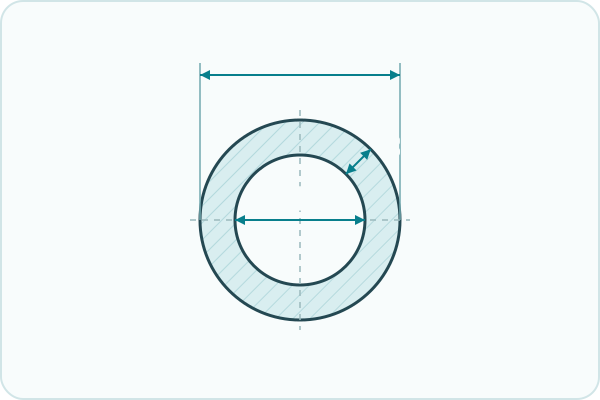
Calculate nominal inside diameter from outside diameter and uniform wall thickness.
What this calculator helps you check
Read the quantities that matter
- Inside diameterd · mm
Compare dimensions, keep the calculation
Add rows to compare alternatives, switch between metric and imperial units, then copy the results or download a CSV with the input dimensions.
Formula
Subtract two walls: d=D−2t. Wall thickness must be positive and less than half the outside diameter to leave an opening.
d = D − 2t; 0 < 2t < DHow to use it
- Use consistent units
Choose the unit system and enter the actual dimensions.
- Dimensions and assumptions
Enter OD and the thickness of one wall in the same units. The result is OD minus two walls.
- Check the result
Review the formula and its assumptions before using the result. Copy or download results with their units and assumptions.
Worked example
Follow one set of dimensions from inputs to calculated results.
Inputs
- Outside diameter
- 60.3 mm
- Wall or plate thickness
- 2 mm
Calculation results
- Inside diameter
- 56.3 mm
OD 60.3 mm minus two walls of 3.6 mm gives ID 53.1 mm.
Limits
The result is geometric and nominal. It is not a minimum guaranteed bore and does not account for wall tolerance, ovality, internal lining or deposits.
Frequently asked questions
The diameter crosses the wall on both sides of the pipe, so one wall thickness is removed at each side.
A diameter crosses one wall on each side of the bore.
The basic result is for the stated wall. For a continuous lining of uniform thickness, account for its thickness on both sides separately.
Continue with a related calculation
Check your own dimensions
Use your actual measurements in the calculator above. Review the units and assumptions before using the result.