
Calculation method
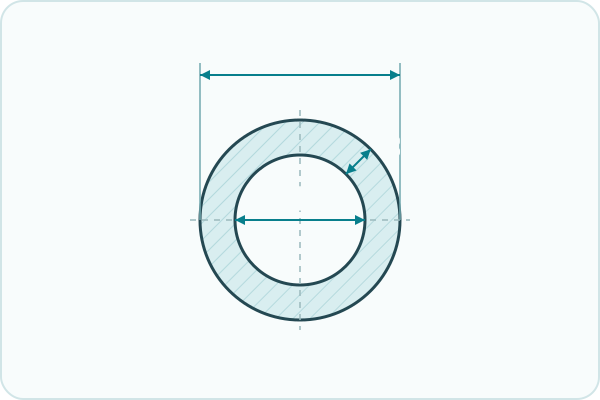
Calculate the internal volume of a straight circular pipe from inside diameter and length.
What this calculator helps you check
Read the quantities that matter
- Internal volumeV · m³
- Internal volumeV · L
Compare dimensions, keep the calculation
Add rows to compare alternatives, switch between metric and imperial units, then copy the results or download a CSV with the input dimensions.
Formula
The passage area is πd²/4. Use the actual inside diameter, convert it to metres, then multiply area by length to obtain cubic metres.
V = π(d/1000)²L/4How to use it
- Use consistent units
Choose the unit system and enter the actual dimensions.
- Dimensions and assumptions
Use the inside diameter and pipe length. Select output units such as litres or US gallons.
- Check the result
Review the formula and its assumptions before using the result. Copy or download results with their units and assumptions.
Worked example
Follow one set of dimensions from inputs to calculated results.
Inputs
- Inside diameter
- 100 mm
- Length
- 10 m
Calculation results
- Internal volume
- 0.078539816 m³
- Internal volume
- 78.539816 L
ID 100 mm and length 10 m give volume 0.078539816 m³, or 78.539816 litres.
Limits
Fittings, valves, tanks, internal deposits and noncircular passages are excluded. OD alone cannot determine contained volume.
Frequently asked questions
No. It calculates the internal space. Pipe metal volume uses the difference between outer and inner cross-sectional areas.
Only the open internal cross-section holds fluid; using the outer diameter counts the wall as available space.
Not unless you explicitly model their internal volumes. This calculation treats the entered length as a straight constant-bore cylinder.
Continue with a related calculation
Check your own dimensions
Use your actual measurements in the calculator above. Review the units and assumptions before using the result.