
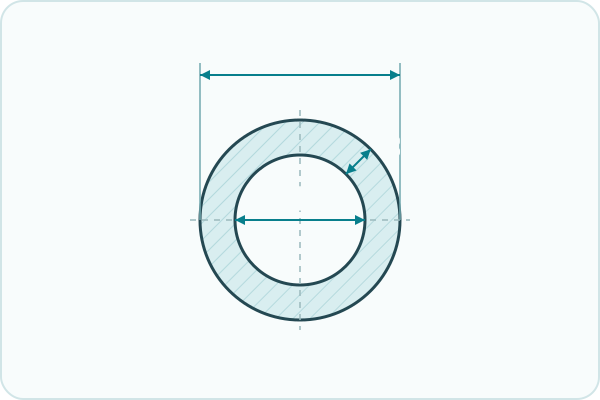
Calculation method
Calculate mean fluid velocity from volumetric flow rate and the pipe's internal diameter.
What this calculator helps you check
Read the quantities that matter
- Flow velocityv · m/s
Compare dimensions, keep the calculation
Add rows to compare alternatives, switch between metric and imperial units, then copy the results or download a CSV with the input dimensions.
Formula
Mean velocity is v=Q/A. The form uses m³/h or US gallons/min for flow and converts to consistent units before dividing by internal flow area.
v = (Q/3600) / [π(d/1000)²/4]How to use it
- Use consistent units
Choose the unit system and enter the actual dimensions.
- Dimensions and assumptions
Use inside diameter and volumetric flow rate. U.S. gallons per minute and Imperial gallons per minute are different units; use the label shown.
- Check the result
Review the formula and its assumptions before using the result. Copy or download results with their units and assumptions.
Worked example
Follow one set of dimensions from inputs to calculated results.
Inputs
- Inside diameter
- 100 mm
- Volumetric flow
- 56.548668 m³/h
Calculation results
- Flow velocity
- 2 m/s
For ID 100 mm and Q=56.54866776 m³/h, mean velocity is approximately 2 m/s.
Limits
This is a mean cross-sectional velocity, not peak velocity, pressure drop, allowable flow or a sizing approval. Fluid conditions and design criteria are outside the calculation.
Frequently asked questions
No. The imperial input option here explicitly uses US gpm, based on the US liquid gallon. Do not enter UK Imperial gallons/min without converting.
No. Flow divided by cross-sectional area gives the mean velocity.
It does not calculate pressure loss, water hammer or permissible velocity. Those require additional system data and a separate design check.
Continue with a related calculation
Check your own dimensions
Use your actual measurements in the calculator above. Review the units and assumptions before using the result.