
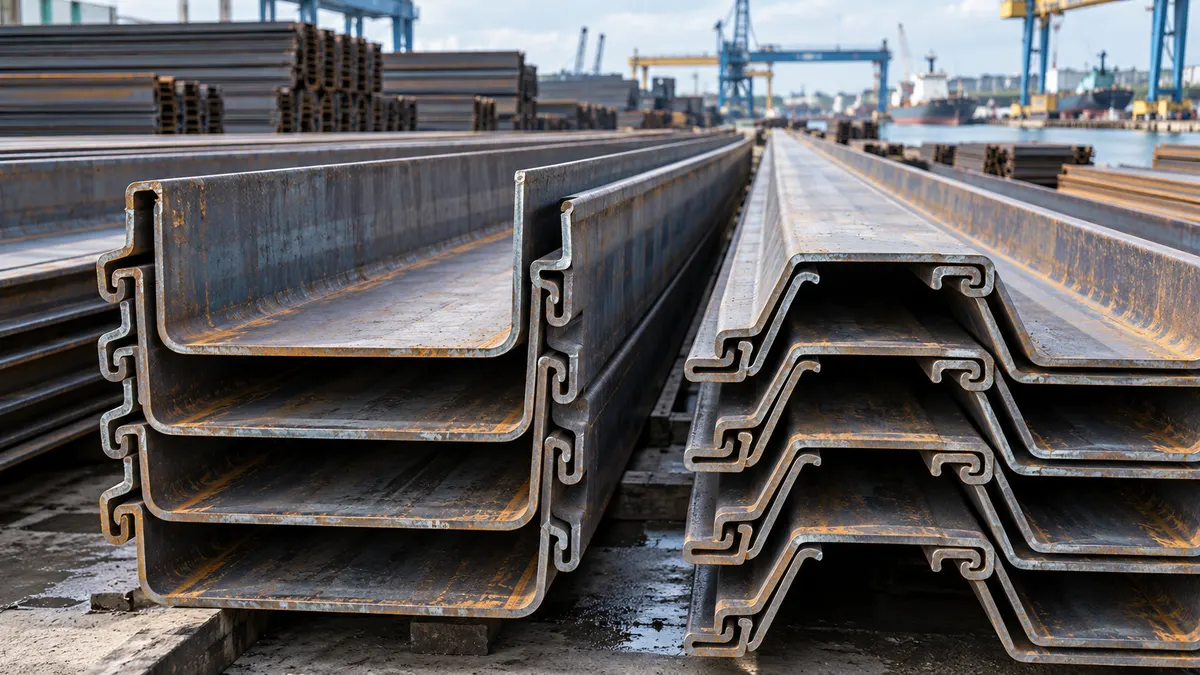
Buyers looking for steel sheet pile types usually need a profile that fits a wall design and can be installed with the equipment available on site. U, Z, and straight-web are profile families, not universal strength grades. A pile type should be selected against the engineer's wall design, required section properties, soil and water conditions, and the intended driving method.
ArcelorMittal's product range includes hot-rolled Z and U sections, straight-web sections, and cold-formed Z, U, and trench sections. That range shows why a request for simply “sheet piles” is too broad for a comparable quotation.
What distinguishes the profile families?
| Profile family | Typical procurement question | Data to confirm |
|---|---|---|
| U section | Does the specified interlock and supplied pairing suit the wall layout? | Section designation, effective width, depth, thickness, section properties, and interlock detail |
| Z section | Does the designated section meet the engineer's required wall properties? | The same section data, plus the interlock location and any project-specific sealing or coating requirement |
| Straight-web section | Is the design a cellular structure that explicitly calls for this profile? | Cell geometry, interlock tension basis, designated section, and construction sequence |
| Cold-formed section | Is the specified section and installation method acceptable for the intended retaining or trench work? | Actual section-property table, grade, length, interlock, and tolerances |
This is a buying checklist, not a substitute for geotechnical or structural design. Profile shape alone does not determine safe wall depth or loading. The engineer must assess earth pressure, groundwater, embedment, corrosion allowance where required, and the temporary or permanent service period.
Match catalog properties to the drawing
For each quoted section, ask for the manufacturer's current section table. At minimum, identify the effective width, height, thickness, mass per length, moment of inertia, and elastic section modulus using the units on the project drawing. ArcelorMittal's U/Z overview lists these fields for its own range; do not copy a value from one manufacturer's profile to another profile that only looks similar.
Confirm whether the proposal is a single pile, a paired unit, or a fabricated corner or junction element. Corners, changes of direction, and tie-ins can require special connectors. The installation contractor should confirm the driving equipment, handling lengths, site access, and whether the proposed interlock system is compatible across all supplied sections.
Build a comparable sheet-pile RFQ
- Include the approved wall drawing and exact profile designation, or state the section properties an alternate must meet.
- Specify steel grade, standard, pile length, quantity, and allowable splices.
- State interlock, corner, sealing, coating, and marking requirements.
- Request section-property data, material certificates, and manufacturing tolerances.
- Confirm packaging, handling, delivery sequence, and destination port or site.
If alternatives are allowed, require the supplier to identify every deviation from the drawing. A different profile can change the number of piles, wall length, installation plan, and required connectors even when its nominal mass seems attractive.
Explore our U-shaped steel sheet pile and Z-type steel sheet pile, then share the design basis through a steel RFQ.
References
Turn the material requirement into an RFQ.
Review the product index or send grade, dimensions, quantity, destination and document requirements to the export desk.