
An IPE beam has parallel flange faces; an IPN beam has tapered inner flange faces. The difference is easiest to see at the cut end. The inside face of an IPE flange runs parallel to its outside face. On an IPN, the flange is thicker next to the web and thinner towards the free edge. Two sections can have the same overall depth without having the same width, mass or connection geometry.
IN THIS ARTICLE
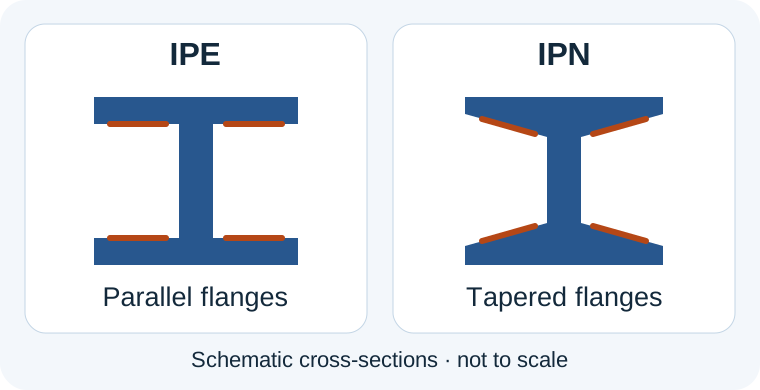
Not to scale. These outlines show the flange-face difference, not a dimensioned section.
IPE 200 vs IPN 200: dimensions and mass
| Feature | IPE 200 | IPN 200 |
|---|---|---|
| Inner flange face | Parallel | Tapered |
| Overall depth, h | 200.0 mm | 200.0 mm |
| Overall flange width, b | 100.0 mm | 90.0 mm |
| Web thickness, t_w | 5.6 mm | 7.5 mm |
| Nominal mass per metre | 22.4 kg/m | 26.2 kg/m |
Scroll horizontally to read all columns
The IPE 200 figures are from British Steel’s European IPE sections table. The IPN 200 figures are from the ArcelorMittal Europe Sections and Merchant Bars catalogue, edition V2026-1, IPN dimensions table. These are nominal catalogue dimensions for the two base designations. They are not measurements of an individual beam.
The 200 in these two designations corresponds to the same 200 mm depth, but the IPE shown is 10 mm wider and the IPN is 3.8 kg heavier per metre. Flange width and mass do not tell you the same thing: the IPN in this comparison has a narrower flange and a thicker web.
How to tell the sections apart on a drawing or a cut end
- Read the full designation. Look for IPE 200 or IPN 200, not just the depth. When the drawing or catalogue includes a letter variant, use the row for that exact designation.
- Look at the inner surface of each flange. Trace the face between the flange edge and the web. An IPE has a straight, parallel face outside the curved transition at the web. An IPN has a sloping inner face. The outside face alone does not identify the section.
- Measure depth and width separately. Depth is the distance between the outside faces of the flanges. Width is the distance across a flange from edge to edge. A single height measurement cannot distinguish these two examples.
The tapered inner face matters when a connection detail assumes a flat, parallel bearing surface. A clip, washer or plate detailed for one cross-section should not be assumed to seat the same way on the other. The section shape is also not a steel grade: the designation identifies the profile, not the material properties.
How to calculate the nominal mass
Multiply the catalogue mass in kg/m by the section length in metres. At 12 m, one IPE 200 is 268.8 kg and one IPN 200 is 314.4 kg, a difference of 45.6 kg per beam. These figures are for the beams alone; individual measured masses need not equal the nominal result.
Where the dimensions standard fits
BS EN 10365:2026, Hot rolled steel channels, I and H sections. Dimensions and masses, includes both IPE parallel-flange I sections and IPN tapered-flange I sections. Its scope covers nominal dimensions and mass, not the design resistance of a beam. It also excludes hot-rolled stainless steel sections. The catalogue comparison above uses the named mill tables; the 200 mm depth, by itself, is not a reason to substitute one section for the other.