
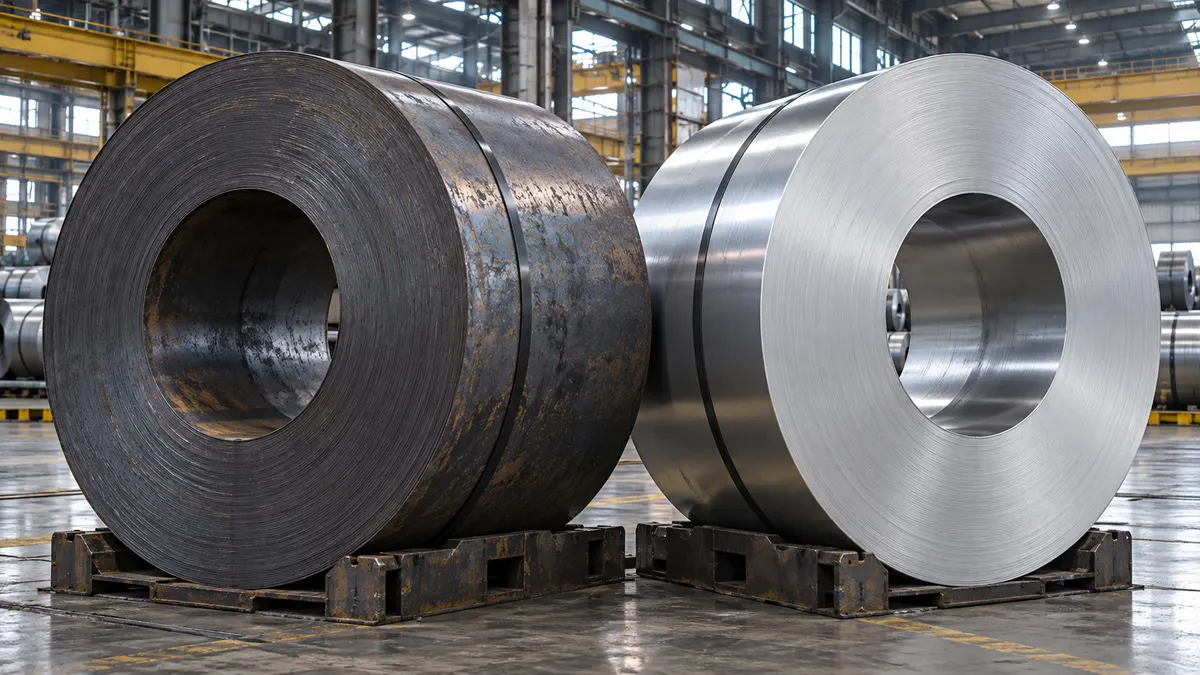
The useful question in hot rolled vs cold rolled steel coil procurement is what the finished part must do. Cold rolling adds processing after hot rolling. ArcelorMittal describes cold-rolled sheet as hot-rolled sheet that is pickled, cold-reduced, and, for some grades, annealed and temper-rolled. These steps can change the available thickness, surface, shape, and forming behavior. The words “hot” and “cold” do not replace a grade or a delivery-condition specification.
Compare the requirements behind the quote
| Requirement | Ask about hot-rolled coil | Ask about cold-rolled coil |
|---|---|---|
| Surface | Whether scale is acceptable or pickling/oiling is required | Surface condition, finish, and whether a later coating or painting step is planned |
| Thickness and shape | Applicable ordered tolerance and flatness for the chosen grade | Applicable tolerance, flatness, and edge condition after cold reduction |
| Forming | The actual bend, roll, weld, or stamping operation | Whether the supplied temper and grade meet drawing and forming needs |
| Documentation | Product standard, grade, dimensions, and inspection certificate | The same documents plus the exact cold-rolled delivery condition |
Cold-rolled material is often chosen where the application values a controlled surface or tighter dimensional requirement. Hot-rolled material can suit products where the drawing permits its surface and tolerances. Neither process is inherently correct for all structural or formed parts. Match the product standard and test requirements to the end use.
Do not confuse process with grade
A buyer may receive two quotations for “carbon steel coil” that differ in much more than rolling route. The grade, nominal thickness, width, coil mass, edge, surface treatment, and inspection basis can all change the delivered product. Before comparing prices, put both suppliers on the same specification and edition. Ask whether the quoted coil is as-rolled, pickled and oiled, full-hard, annealed, or another explicitly defined delivery condition.
The word “cold rolled” alone does not guarantee good formability. ArcelorMittal notes that full-hard cold-rolled product normally needs additional processing when ductility is important. Where bending or deep drawing is planned, confirm the grade and delivery condition against the part drawing and request the supplier's applicable test data.
What to send with a coil inquiry
- Finished part or process: cutting, roll-forming, stamping, welding, or coating.
- Standard, grade, and required mechanical-property basis.
- Ordered thickness and width, tolerances, edge, inner diameter, and coil weight range.
- Surface and delivery condition, including pickling, oiling, annealing, or protective film when relevant.
- Inspection documents, packaging, destination, and whether the order is for trial or repeat production.
If a supplier proposes a route different from the drawing, request written approval before placing the order. A process change can alter downstream tooling, appearance, and acceptance checks even when the nominal grade name looks similar.
Browse carbon steel coil and an available 1008 cold-rolled steel coil. Send the finished-part requirements with your steel RFQ so the quoted material matches the intended production route.
References
Turn the material requirement into an RFQ.
Review the product index or send grade, dimensions, quantity, destination and document requirements to the export desk.